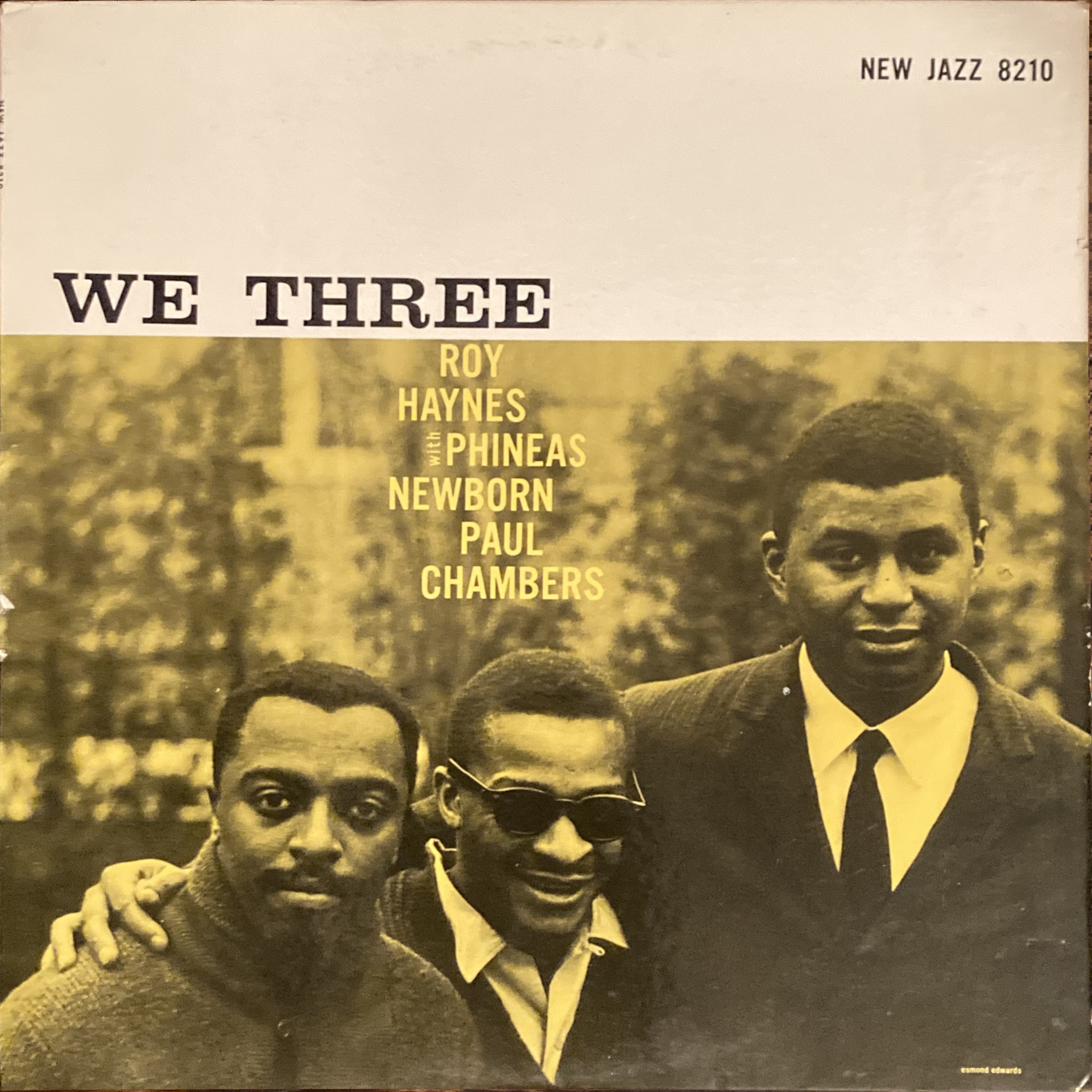

Label: NEW JAZZ
No.: NJLP-8210
Title: WE THREE
Musician: ROY HAYNES
Recorded: 1958/11/14
Monaural
Cover address: 203 SO. WASHINGTON AVE. BERGENIFIELD N.J.
Coating
Groove Guard
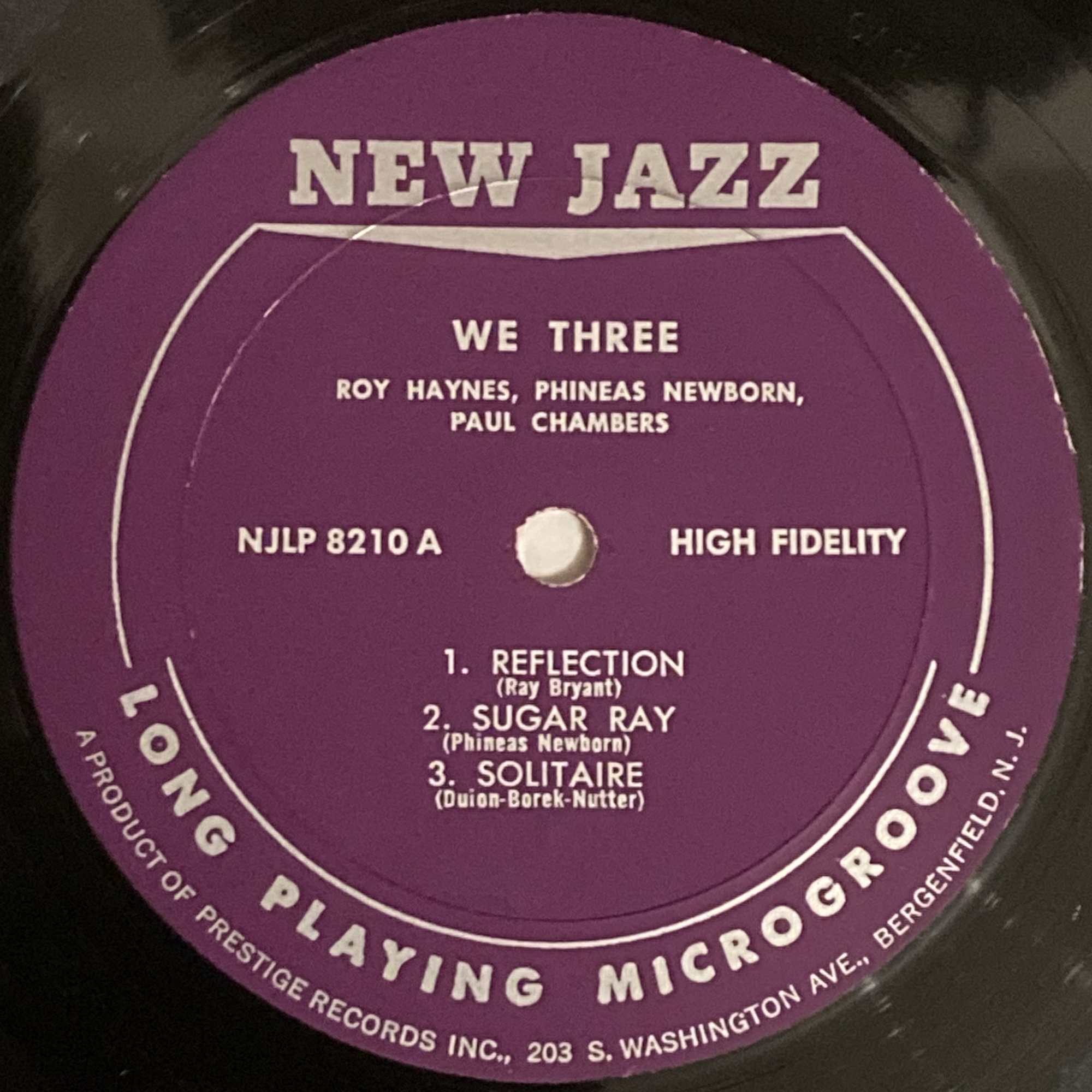
Label Side-A
Purple Background
Silver Letter
Address: 203 S. WASHINGTON AVE. BERGENIFIELD N.J.
Deep Groove無し
Dead Wax Info: RVGスタンプ, NJLP-8210-A
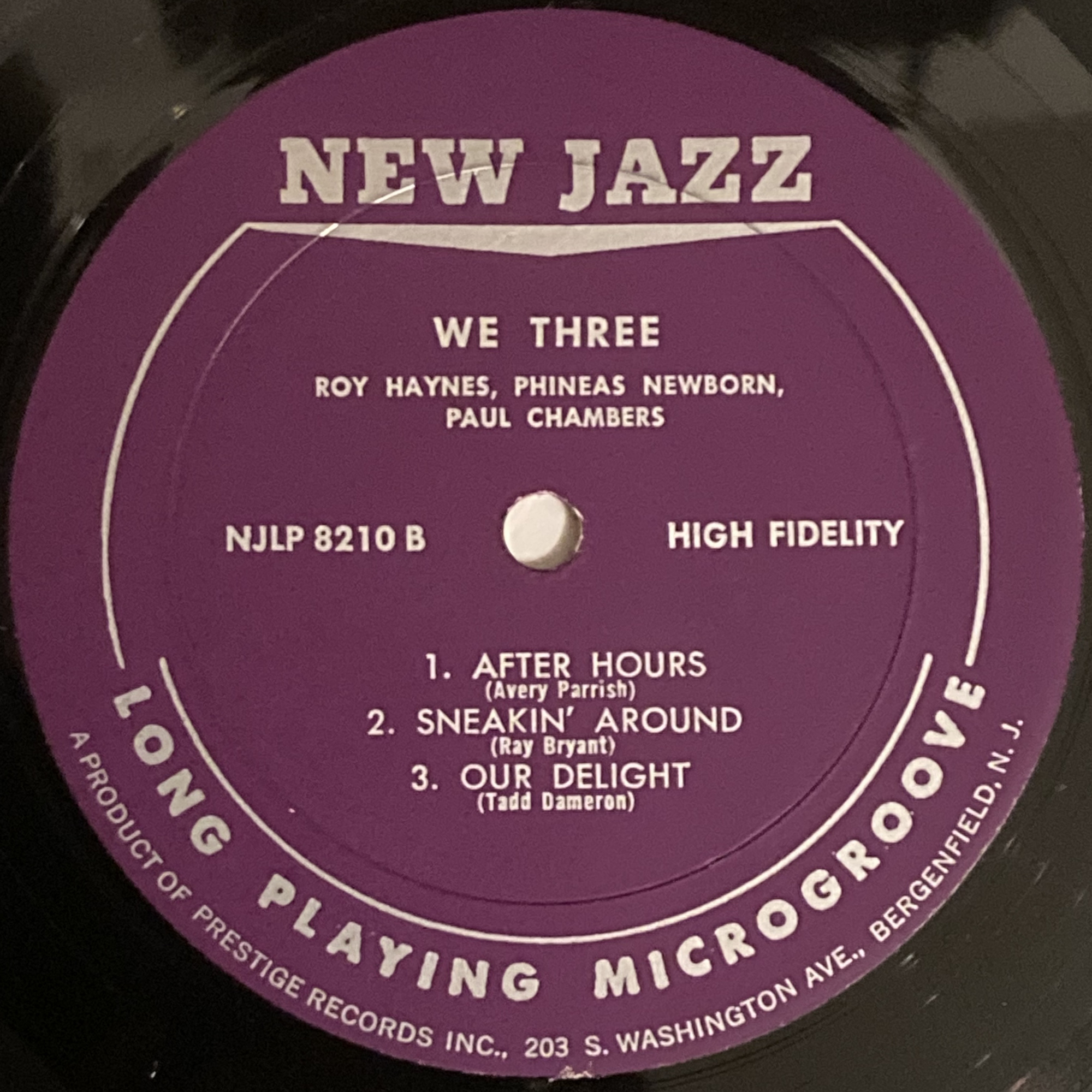
Label Side-B
Purple Background
Silver Letter
Address: 203 S. WASHINGTON AVE. BERGENIFIELD N.J.
Deep Groove無し
Dead Wax Info: RVGスタンプ, NJLP-8210-B
Personnel-
Drums: Roy Haynes
Bass: Paul Chambers
Piano: Phineas Newborn Jr.
Tracks-
Side-A
1) Reflection 4’22”
2) Sugar Ray 6’26”
3) Solitaire 8’53”
Side-B
1) After Hours 11’18”
2) Sneakin’ Around 4’23”
3) Our Delight 4’01”
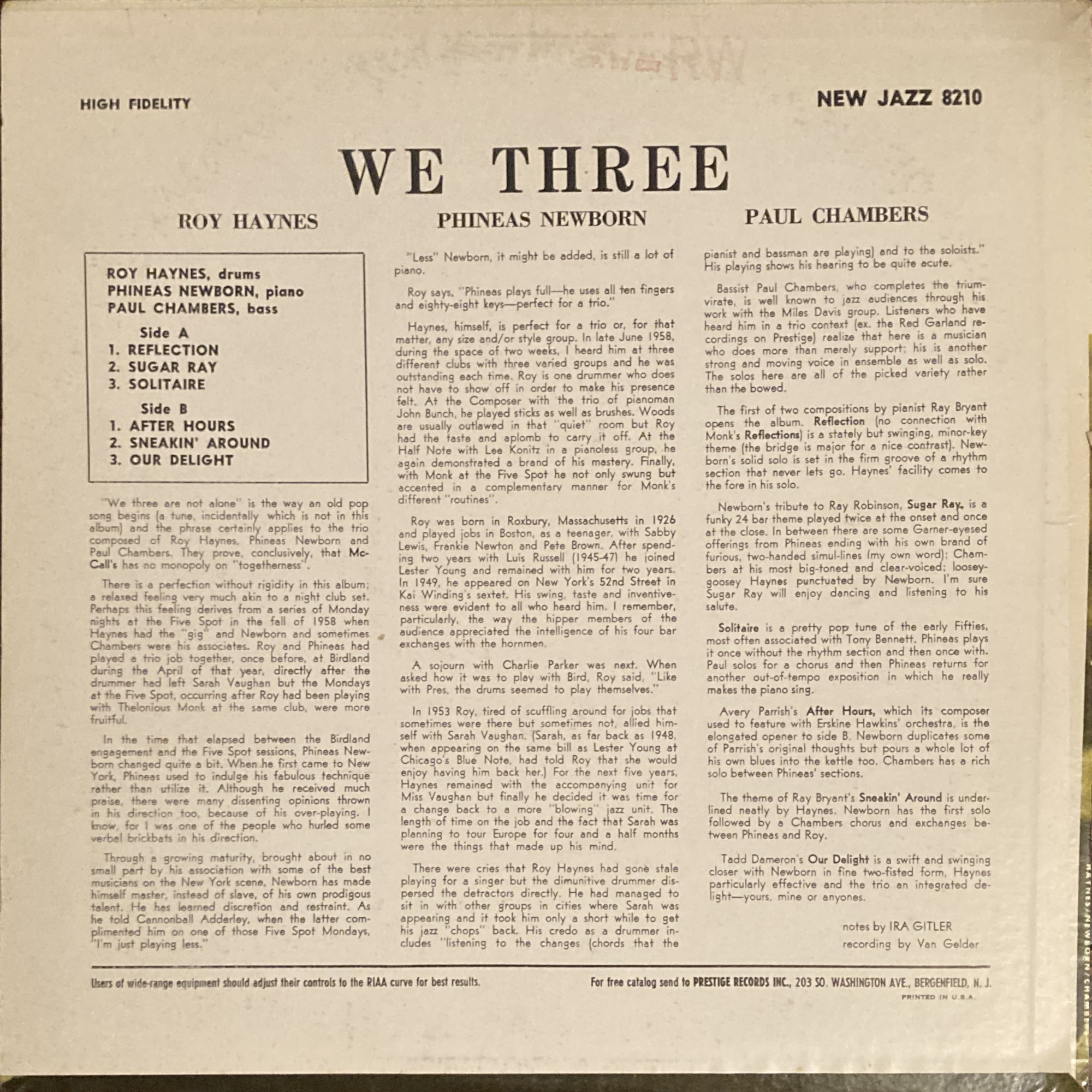
<裏ジャケ原文>
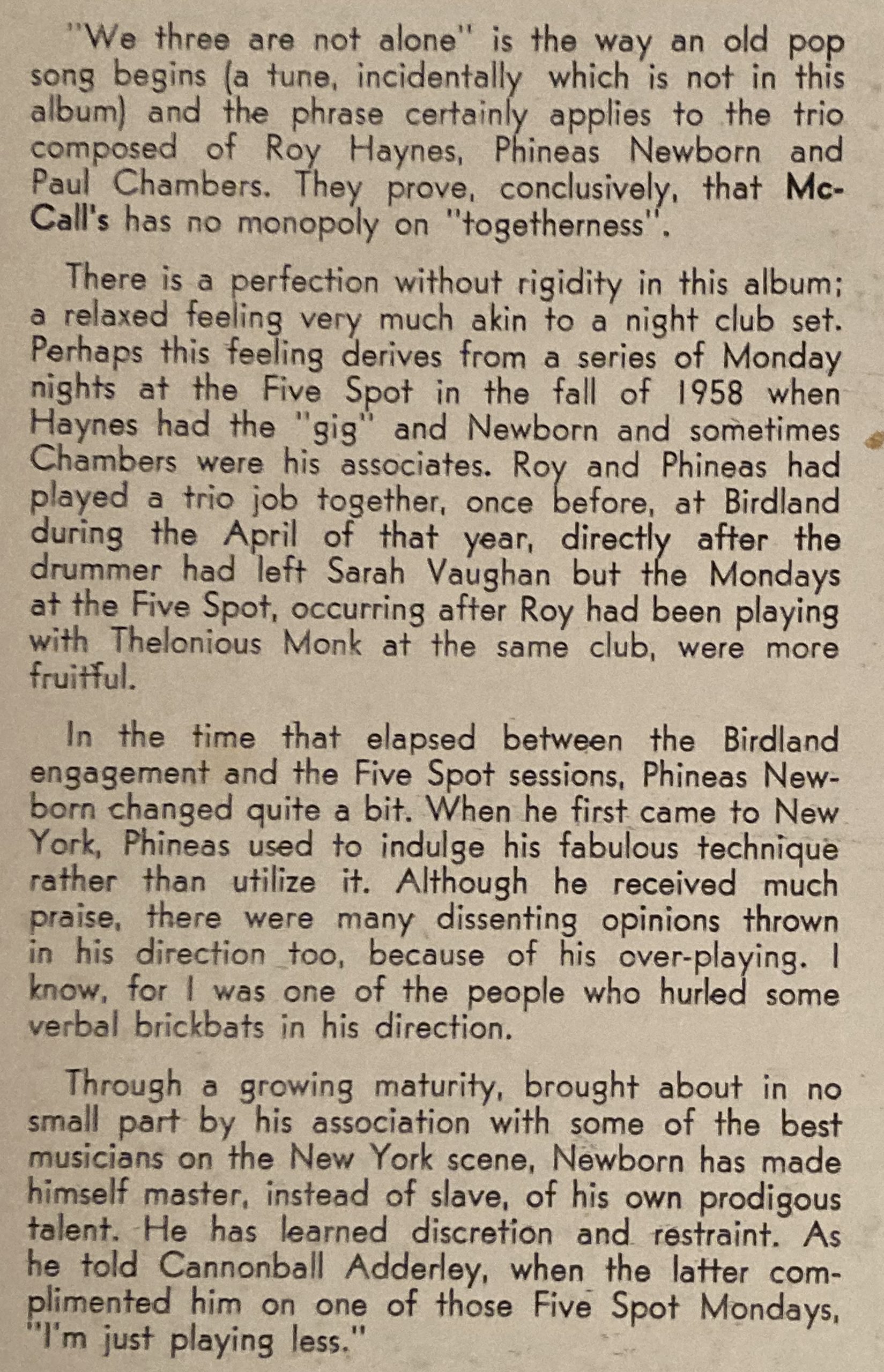
“We three are not alone” is the way an old pop song begins (a tune, incidentally which is not in this album) and the phrase certainly applies to the trio composed of Roy Haynes, Phineas Newborn and Paul Chambers. They prove, conclusively, that Mc- Call’s has no monopoly on “togetherness”.
There is a perfection without rigidity in this album; a relaxed feeling very much akin to a night club set. Perhaps this feeling derives from a series of Monday nights at the Five Spot in the fall of 1958 when Haynes had the “gig” and Newborn and sometimes. Chambers were his associates. Roy and Phineas had played a trio job together, once before, at Birdland during the April of that year, directly after the drummer had left Sarah Vaughan but the Mondays at the Five Spot, occurring after Roy had been playing with Thelonious Monk at the same club, were more fruitful.
In the time that elapsed between the Birdland engagement and the Five Spot sessions, Phineas New- born changed quite a bit. When he first came to New York, Phineas used to indulge his fabulous technique rather than utilize it. Although he received much praise, there were many dissenting opinions thrown in his direction too, because of his over-playing. I know, for I was one of the people who hurled some verbal brickbats in his direction.
Through a growing maturity, brought about in no small part by his association with some of the best musicians on the New York scene, Newborn has made himself master, instead of slave, of his own prodigous talent. He has learned discretion and restraint. As he told Cannonball Adderley, when the latter com- plimented him on one of those Five Spot Mondays, “I’m just playing less.”
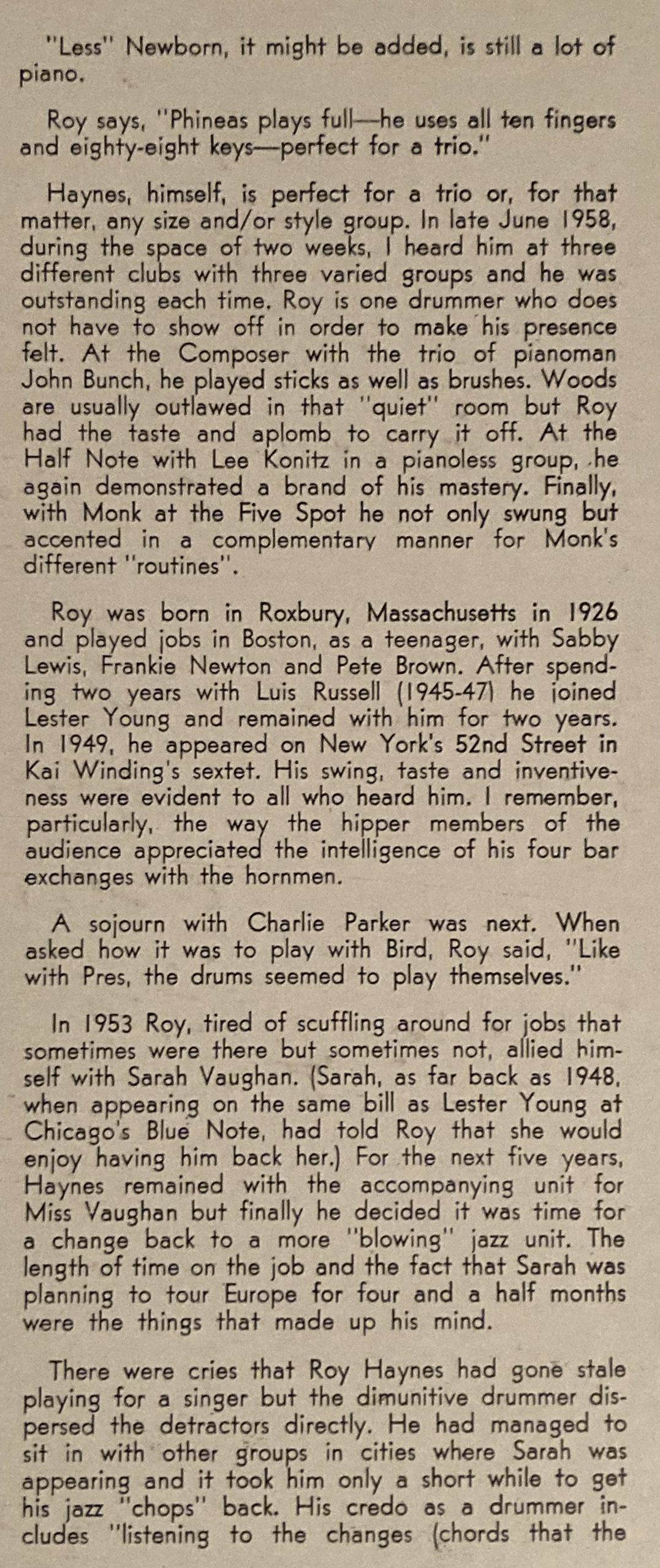
“Less” Newborn, it might be added, is still a lot of piano.
Roy says, “Phineas plays full-he uses all ten fingers and eighty-eight keys-perfect for a trio.”
Haynes, himself, is perfect for a trio or, for that matter, any size and/or style group. In late June 1958, during the space of two weeks, I heard him at three different clubs with three varied groups and he was outstanding each time. Roy is one drummer who does not have to show off in order to make his presence felt. At the Composer with the trio of pianoman John Bunch, he played sticks as well as brushes. Woods are usually outlawed in that “quiet” room but Roy had the taste and aplomb to carry it off. At the Half Note with Lee Konitz in a pianoless group, he again demonstrated a brand of his mastery. Finally, with Monk at the Five Spot he not only swung but accented in a complementary manner for Monk’s different “routines”.
Roy was born in Roxbury, Massachusetts in 1926 and played jobs in Boston, as a teenager, with Sabby Lewis, Frankie Newton and Pete Brown. After spend- ing two years with Luis Russell (1945-47) he joined Lester Young and remained with him for two years. In 1949, he appeared on New York’s 52nd Street in Kai Winding’s sextet. His swing, taste and inventive- ness were evident to all who heard him. I remember, particularly, the way the hipper members of the audience appreciated the intelligence of his four bar exchanges with the hornmen.
A sojourn with Charlie Parker was next. When asked how it was to play with Bird, Roy said, “Like with Pres, the drums seemed to play themselves.”
In 1953 Roy, tired of scuffling around for jobs that sometimes were there but sometimes not, allied him- self with Sarah Vaughan. (Sarah, as far back as 1948, when appearing on the same bill as Lester Young at Chicago’s Blue Note, had told Roy that she would enjoy having him back her.) For the next five years, Haynes remained with the accompanying unit for Miss Vaughan but finally he decided it was time for a change back to a more “blowing” jazz unit. The length of time on the job and the fact that Sarah was planning to tour Europe for four and a half months were the things that made up his mind.
There were cries that Roy Haynes had gone stale playing for a singer but the dimunitive drummer dis- persed the detractors directly. He had managed to sit in with other groups in cities where Sarah was appearing and it took him only a short while to get his jazz “chops” back. His credo as a drummer in- cludes “listening to the changes (chords that the pianist and bassman are playing) and to the soloists.” His playing shows his hearing to be quite acute.
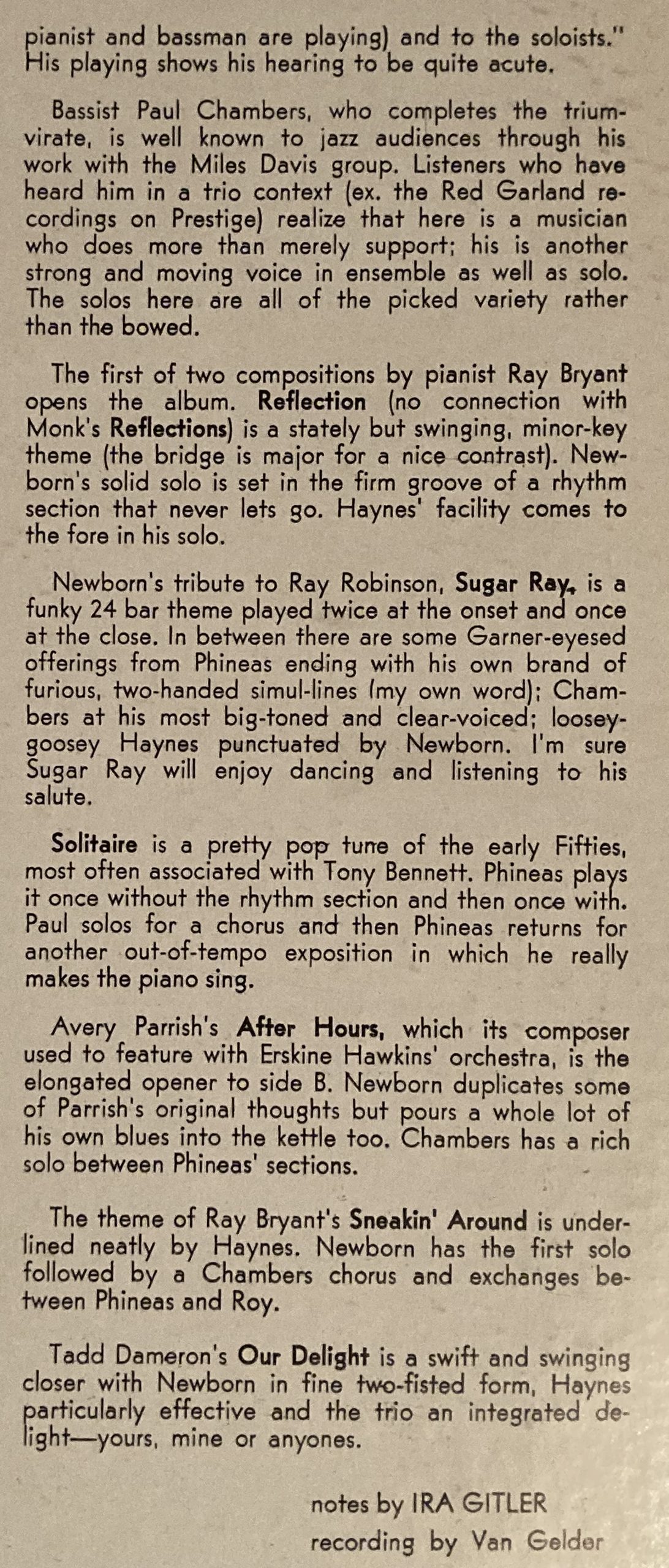
Bassist Paul Chambers, who completes the trium- virate, is well known to jazz audiences through his work with the Miles Davis group. Listeners who have heard him in a trio context (ex. the Red Garland re- cordings on Prestige) realize that here is a musician who does more than merely support; his is another strong and moving voice in ensemble as well as solo. The solos here are all of the picked variety rather than the bowed.
The first of two compositions by pianist Ray Bryant opens the album. Reflection (no connection with Monk’s Reflections) is a stately but swinging, minor-key theme (the bridge is major for a nice contrast). New- born’s solid solo is set in the firm groove of a rhythm section that never lets go. Haynes’ facility comes to the fore in his solo.
Newborn’s tribute to Ray Robinson, Sugar Ray, is a funky 24 bar theme played twice at the onset and once at the close. In between there are some Garner-eyesed offerings from Phineas ending with his own brand of furious, two-handed simul-lines (my own word): Cham- bers at his most big-toned and clear-voiced; loosey- goosey Haynes punctuated by Newborn. I’m sure Sugar Ray will enjoy dancing and listening to his salute.
Solitaire is a pretty pop tune of the early Fifties, most often associated with Tony Bennett. Phineas plays it once without the rhythm section and then once with. Paul solos for a chorus and then Phineas returns for another out-of-tempo exposition in which he really makes the piano sing.
Avery Parrish’s After Hours, which its composer used to feature with Erskine Hawkins’ orchestra, is the elongated opener to side B. Newborn duplicates some of Parrish’s original thoughts but pours a whole lot of his own blues into the kettle too. Chambers has a rich solo between Phineas’ sections.
The theme of Ray Bryant’s Sneakin’ Around is under- lined neatly by Haynes. Newborn has the first solo followed by a Chambers chorus and exchanges be- tween Phineas and Roy.
Tadd Dameron’s Our Delight is a swift and swinging closer with Newborn in fine two-fisted form, Haynes particularly effective and the trio an integrated de- light-yours, mine or anyones.
notes by IRA GITLER recording by Van Gelder
Users of wide-range equipment should adjust their controls to the RIAA curve for best results.
For free catalog send to PRESTIGE RECORDS INC., 203 SO. WASHINGTON AVE., BERGENFIELD, N. J.
PRINTED IN USA.
<裏ジャケ和訳>
このアルバムには、堅苦しさのない完璧さがある。それは、ナイトクラブでの演奏を彷彿とさせる、肩の力の抜けた雰囲気だ。おそらくこの感覚は、1958年秋、ニューヨークのジャズクラブ「ファイブ・スポット」で毎週月曜夜に行われていた一連のセッションに由来するのだろう。そこではロイ・ヘインズがリーダーを務め、フィニアス・ニューボーン、そして時にはポール・チェンバースが共演者として参加していた。ロイとフィニアスは、その年の4月にも「バードランド」でトリオとして共演したことがある。それはロイがサラ・ヴォーンのバンドを離れてすぐのことだったが、「ファイブ・スポット」での月曜のセッションの方が、より実り多いものとなった。ちなみにロイは、その同じ店でセロニアス・モンクとも共演していた。
「バードランド」での共演から「ファイブ・スポット」でのセッションに至るまでの間に、フィニアス・ニューボーンは大きく変化した。ニューヨークに出てきた当初、フィニアスは自身の驚異的なテクニックを「駆使する」というより、むしろそのテクニックに「溺れている」ようなところがあった。高い評価を受ける一方で、弾きすぎ(オーバー・プレイ)を理由に批判を浴びることも少なくなかった。私自身、彼に対して厳しい言葉を投げかけた人間の一人だったので、よく覚えている。
ニューヨークの音楽シーンで最高峰のミュージシャンたちと交流を重ねる中で、フィニアスは成熟していった。彼は自身の並外れた才能の「奴隷」ではなく、「主人」となる術を身につけたのだ。彼は、節度と抑制を学んだのである。「ファイブ・スポット」でのある月曜の夜、キャノンボール・アダレイから演奏を称賛された際、フィニアスはこう答えている。「ただ、弾く音を減らしただけさ」
付け加えておくと、その「減らした」演奏であっても、フィニアスのピアノは依然として圧倒的な密度を誇っている。
ロイはこう語る。「フィニアスの演奏は実に充実している。10本の指と88鍵すべてを使い切るんだ。トリオには完璧だよ」
ロイ・ヘインズ自身もまた、トリオはもちろん、どんな編成やスタイルのグループであっても完璧にこなせるドラマーだ。1958年6月下旬の2週間、私は彼が異なる3つのクラブで、それぞれ別のグループと演奏しているのを聴いたが、どの時も傑出していた。ロイは、自分の存在を誇示するためにわざわざ目立つような真似をする必要のない、そんなドラマーの一人である。 「ザ・コンポーザー」でのジョン・バンチ(ピアノ)を擁するトリオにおいて、彼はブラシだけでなくスティックも使用した。この「静かな」店では通常、スティックの使用は禁じられていたが、ロイにはそれを違和感なくこなすだけのセンスと落ち着きが備わっていた。また、「ハーフ・ノート」では、ピアノレスの編成でリー・コニッツと共演し、ここでも彼ならではの卓越した技量を披露した。さらに、「ファイブ・スポット」でセロニアス・モンクと共演した際には、単にスウィングするだけでなく、モンク特有の「ルーティン」に対して、それを引き立てるようなアクセントを巧みに加えた。
ロイは1926年、マサチューセッツ州ロックスベリーに生まれた。10代の頃にはボストンで、サビー・ルイス、フランキー・ニュートン、ピート・ブラウンらと共演している。その後、ルイス・ラッセルのバンドで2年間(1945〜47年)活動し、続いてレスター・ヤングのバンドに2年間在籍した。1949年には、ニューヨークの52丁目にて、カイ・ウィンディング率いるセクステットの一員として出演した。彼のスウィング感、センス、そして独創性は、演奏を耳にした誰もが認めるところであった。特に印象に残っているのは、客席の感度の高い聴衆たちが、彼がホーン奏者たちと繰り広げる4小節の掛け合い(フォー・バー・エクスチェンジ)の中に、知的なやり取りを見出し、高く評価していたことである。
続いて、チャーリー・パーカーとの共演が控えていた。パーカー(愛称「バード」)との演奏がどのようなものだったかと尋ねられた際、ロイはこう答えた。「レスター・ヤング(愛称「プレズ」)の時と同じで、まるでドラムが勝手に鳴っているような感覚だったよ」
1953年、仕事がある時もあればない時もあるという不安定な状況に疲れ果てていたロイは、サラ・ヴォーンのバンドに加わることにした。(サラは1948年、シカゴの「ブルー・ノート」でレスター・ヤングと同じステージに立った際、すでにロイに対して「いつか私のバックで叩いてほしい」と伝えていたのだ。)その後5年間、ヘインズはサラ・ヴォーンの伴奏を務めたが、やがて彼は、もっと自由に即興演奏(ブローイング)ができるジャズ・バンドへ戻るべき時が来たと判断した。長年同じ仕事を続けてきたこと、そしてサラが4ヶ月半にわたるヨーロッパ・ツアーを計画していたことが、彼の決断を後押しした。
「歌手の伴奏ばかりしていては、ロイ・ヘインズの腕も鈍ってしまうのではないか」という声もあったが、小柄なこのドラマーは、そうした批判を即座に覆してみせた。サラの公演先で他のグループのセッションに参加する機会をうまく作り出し、短期間のうちにジャズ・ミュージシャンとしての勘を取り戻したのである。ドラマーとしての彼の信条には、「チェンジ(ピアニストやベーシストが奏でるコード進行)やソリストの演奏に耳を傾けること」が含まれている。彼の演奏を聴けば、その聴覚がいかに鋭いかがよくわかる。
トリオのもう一人のメンバーであるベーシストのポール・チェンバースは、マイルス・デイヴィスのグループでの活動を通じて、ジャズ・ファンにはよく知られた存在だ。トリオ編成での彼の演奏(例えば、プレスティッジ・レーベルからリリースされたレッド・ガーランドの録音など)を聴いたことのある人なら、彼が単なる伴奏者にとどまらないミュージシャンであることを知っているはずだ。アンサンブルにおいてもソロにおいても、彼は力強く、心を揺さぶる「声」を響かせる。本作における彼のソロは、すべて弓を使わず、指で弦を弾くピチカート奏法によるものだ。
アルバムの幕開けを飾るのは、ピアニストのレイ・ブライアントによる2曲の自作曲のうちの1曲である。「リフレクション」(セロニアス・モンクの「リフレクションズ」とは無関係)は、堂々としつつもスウィング感あふれるマイナー調のテーマで、ブリッジ部分がメジャー調になっていることで心地よい対比を生み出している。ニューボーンによる堅実なソロは、決して緩むことのないリズム・セクションの強固なグルーヴの上に展開されている。ヘインズの卓越した技術が、彼のソロで際立っている。
ニューボーンがレイ・ロビンソン(シュガー・レイ)に捧げた「シュガー・レイ」は、ファンキーな24小節のテーマで構成されており、冒頭で2回、終盤で1回演奏される。その間には、エロール・ガーナーを彷彿とさせるアプローチが散りばめられており、最後にはニューボーンならではの、両手を駆使した猛烈なライン(私が勝手に「シマル・ライン」と呼んでいるもの)が展開される。ポール・チェンバースは、太く明瞭なトーンを響かせ、ヘインズはリラックスしたドラミングでニューボーンの演奏にアクセントを加えている。シュガー・レイ本人も、このトリビュートを聴きながら、きっと楽しく踊り出すことだろう。
「ソリテア」は50年代初頭の美しいポピュラー・ソングで、トニー・ベネットの歌唱でよく知られている。ニューボーンは、まずリズム・セクションなしで1回演奏し、続いてリズム・セクションを加えてもう1回演奏する。ポールが1コーラスのソロをとった後、ニューボーンが再びテンポにとらわれない形でテーマを提示し、ピアノを心から歌わせている。
エイヴリー・パリッシュ作の「アフター・アワーズ」は、作曲者自身がアースキン・ホーキンス楽団で披露していた曲であり、B面のオープニングを飾る長尺のナンバーとなっている。ニューボーンはパリッシュの原曲のアイデアを活かしつつ、そこに彼自身のブルースの感覚をたっぷりと注ぎ込んでいる。ニューボーンの演奏パートの間には、チェンバースによる豊かなソロが挿入されている。
レイ・ブライアント作の「スニーキン・アラウンド」では、ヘインズがテーマを巧みに際立たせている。ニューボーンが最初のソロをとり、続いてチェンバースが1コーラスのソロを披露。その後、ニューボーンとヘインズの間で掛け合い(交換演奏)が繰り広げられる。
タッド・ダメロン作の「アワー・ディライト」は、スピーディーでスウィング感あふれる締めくくりの曲だ。ここでのニューボーンは、両手を存分に使った力強いプレイを見せ、ヘインズのドラミングも非常に効果的である。トリオ全体が見事に一体となっており、まさに誰が聴いても楽しめる素晴らしい演奏だ。
ライナーノーツ:アイラ・ギトラー 録音:ヴァン・ゲルダー
ワイドレンジな再生機器をお使いの方は、最良の結果を得るために、コントロールをRIAAカーブに合わせて調整してください。
無料カタログをご希望の方は、PRESTIGE RECORDS INC. (203 SO. WASHINGTON AVE., BERGENFIELD, N. J.) までご連絡ください。
米国製。
※訳文の制作にはGoogleドライブとGoogle翻訳のお世話になりました。
コメント